"Fire is motion / Work is repetition / This is my document / We are all all we've done / We are all all we've done / We are all all we've done / We are all all defenses."

- Cap'N Jazz, "Oh Messy Life," Analphabetapolothology
Showing posts with label history. Show all posts

Thursday, September 01, 2011

"tantalized" by mythology!


i was reading East of Eden today during my lunch break when i caught a reference to Tantalus, from Greek mythology. East of Eden is a book i've been (re?*)reading because i thoroughly enjoyed it in high school, and living in the same setting where the story takes place imparts a magic realism to the story that makes it read even more like history than fiction. furthermore, i am convinced Steinbeck and i would have been besties if we just got the timing right. **although now that i'm actually nearing the end of the book, i'm not even positive i finished it the first(?) time i read it.

anyway, lucky for me, i had quick access to a computer and Wikipedia, and was able to read up about Tantalus. what a cute story!

In mythology, Tantalus became one of the inhabitants of Tartarus, the deepest portion of the Underworld, reserved for the punishment of evildoers...

Tantalus was initially known for having been welcomed to Zeus' table in Olympus. There he is said to have misbehaved and stolen ambrosia and nectar to bring it back to his people, and revealed the secrets of the gods.

Most famously, Tantalus offered up his son, Pelops, as sacrifice. He cut Pelops up, boiled him, and served him up in a banquet for the gods. The gods became aware of the gruesome nature of the menu, so they didn't touch the offering [...] The Greeks of classical times claimed to be horrified by Tantalus's doings; cannibalism, human sacrifice and infanticide were atrocities and taboo.

Tantalus's punishment for his act, now a proverbial term for temptation without satisfaction (the source of the English word tantalise), was to stand in a pool of water beneath a fruit tree with low branches. Whenever he reached for the fruit, the branches raised his intended meal from his grasp. Whenever he bent down to get a drink, the water receded before he could get any. This fate has cursed him with eternal deprivation of nourishment. [source: Wikipedia]


From Susanna Clarke's "Jonathan Strange and Mr. Norrell":
I dare say you have heard of Tantalus? The wicked king who baked his little son in a pie and ate him? He has been condemned to stand up to his chin in a pool of water he cannot drink, beneath a vine laden with grapes he cannot eat. This wine is made from those grapes. And, since the vine was planted there for the sole purpose of tormenting Tantalus, you may be sure the grapes have an excellent flavour and aroma-and so does the wine. [source]

this was a fantastic learning moment for me: i never knew the word "tantalize" came from Greek mythology, and furthermore, i had no idea we've been misusing/altering the word from its original intended meaning. i've always heard "tantalizing" used to mean "supremely appealing" or "tempting," neither of which pay due homage to Tantalus's situation of being perpetually and torturously out of reach of what he wants.

i thought about how a story like this would have been great to share with students if i were still teaching; it would be a powerful mnemonic device to help them remember the meaning of the word "tantalize." the imagery is great, albeit a little violent, but totally captivating and engrossing for even South Central kids. it also got me thinking about the curious nature of stories and mythology.

i never took a mythology class in high school - i was too busy taking AP Psych and Stats in preparation for what i thought would be a career in psychology - but a lot of my high school friends did. i remember seeing this book a lot in the cafeteria:

in retrospect, i wish i had taken time to study mythology in greater depth. my Greek/Roman history is real shaky, but i've always been fascinated by the stories in their mythology, and how they seem to bleed and blur the lines of historical fact and fiction. i appreciate how imbued Greek history is with myth and vice versa. the same can be said of Biblical history as well, i suppose. it's fascinating to me how blurry the lines between "myth" and "history" are.

this was especially tangible on ben's and my travels through Turkey a few summers ago. for example, we visited the modern day Çanakkale, the purported site of ancient Troy. there were historical sites and landmarks all over that place, juxtaposed with trappings of modern life. case in point: ben is enjoying some Turkish ice cream beside the wooden horse from the movie Troy (yes, that really awful one with Brad Pitt).

in another part of Turkey (one which we did not personally visit), the existence of a "weeping" rock formation gives credo to the ancient myth about Niobe, whose hubris offended the gods and caused them to punish her by murdering all 14 of her sons and daughters and turning her to stone. the "Weeping Rock" in Turkey, amazingly, weeps rainwater through its porous surface, and resembles the face of a woman.


it at once fascinates me to the point of glee and confuses me to the point of irritability, the way history and myth blend together, making it unclear to me what magic is possible and believable because it happened, and what magic is imagined lore made truth thru centuries of faith. because if i am to believe the Trojan War really happened, that means Zeus and Achilles and etc. were real too, right? and if that's so, what's to say all the other wonders of the ancient world weren't also, at some point, real?

it's blowing my mind a little bit.

Thursday, April 07, 2011

uncommonly misinformed

today, as i was preparing for a lunch-time interview with a charter school in New York, i discovered that said charter school organization is currently mis-appropriating the name of Horace Mann to perpetuate an idea of education he would have fundamentally opposed.

the charter organization says on their website (in their history section, no less!):
Playing on Horace Mann's notion of the "common school," and born of the fact that too many of today's educational institutions steer toward mediocrity, Uncommon was founded to create more uncommon schools - uncommonly good, extraordinary, autonomous, and distinctive.
Mann's idea of the common school was not common in the sense of "mediocre," but in the sense of community. Mann believed, and i agree, that the school should be a public space, that the school is central to community life and longevity. furthermore, and this is key, Mann maintained that the most important purpose of the school, the great purpose underlying the establishment of a public education system, was to strive for social harmony, through acting as "the great equalizer" of social inequalities and injustices. what makes this so ironic is that Mann believed, in order for schools to achieve this great social purpose, that schools should be sponsored and participated in by an interested public, and that this public interest in the education of its citizens would profoundly benefit both the educational system and society. this meant, in Mann's time, that the school system should be sustained, paid for and controlled by an interested public. Mann was, after all, known as the "father of American public education." this, however, is contrary to the practices of charter schools, who take public funds away from public school systems, put them toward schools where the teachers are not allowed to unionize, and students are plucked from the masses to constitute a "lucky" elite that will now have the chance to try for college educations.* all this in addition to undermining the public school systems, minimizing the problems of education to one of "mismanagement" and offering an alternative that supplants a longterm solution.

granted, i applaud the efforts of the charter school movements to create upward mobility among impoverished communities by giving them a track towards college educations, but i have to ask myself, when i read things like this, if 1) they are perhaps placing too much credo in the difference a college education will make. after all, more college graduates are finishing their degrees only to find themselves just as jobless as before, and higher education is increasingly undervalued and over-expected. 2) this reflects a problem i detect with lots of these education reform movements (cf. TFA): they seem to think that a lack of quality educational opportunities is the only problem plaguing an impoverished community (or, is it that it's the easiest problem to get recent college grads to commit to?) but everyone knows that poverty and lack of education and crime and etc. are SOCIETAL problems that need sweeping societal reforms in order to address. in a way, these problems are worsened when we delude ourselves into thinking that they are simple problems a few good teachers working in isolation can make go away. and certainly the process of devaluing and demonizing the public school system as a failed trap doesn't help matters, because how are we ever going to invest any care, attention and money into reforming our schools if we keep building new charter schools?

needless to say, i probably won't be working for them. because i don't have much confidence in our educational philosophies being aligned, for one, but also because they might find this before i have the chance to interview, in which case i think they'll know how i feel.


*is it just me, or is there something extremely weird and disturbing about randomly selecting a few students from a community to participate in a better education while others in the community get left behind. Blue Eyes versus Brown Eyes, anyone?

Wednesday, March 02, 2011

back when "Walkman" meant something

my friend Kathee pointed this out to me and it was just too good not to share.

this compendium of pop music is really super fantastic. i mean, you know, it might not be everyone’s bag, but for me, well, let’s just say i’m a sucker for all things nostalgic (that should be the name of a blog...) it reminds me of middle school bus rides, field trips, and track practice. really awkward middle school dances and driving in the car with my mom when she still listened to “adult contemporary” (Kiss FM and Delilah anyone!?) and hadn’t discovered NPR yet. it reminds me of playing in the orchestra in my ghetto middle school and playing the piano part in “All My Life” – the only recognizable section of the song in a really poorly arranged transcription. and it reminds me of joking around in the dorm with my college roommates, playing all the “hits” and making up dance moves like we were in an endless sleepover party, when we should have been writing term papers. *sigh* good times. it reminds me that once, popular music was a way to connect to a wider scene and to have things in common to jam to. as middle schoolers, we never intellectualized stuff ("man, the bump in that part was greeeaat." "shit, phenomenal use of autotune! cheeky!") but it was just about what was catchy, what got stuck in yr head, what was worth sitting by the radio, cassette player in hand, in order to record and keep. back when we didn't have ipods and digital music and the internet and music was made precious by the radio – back when some songs were worth sitting thru the commercial breaks for! and, i’ll admit, i still secretly jam to at least 80% of this list when i’m alone and in need of some cheer.

another really great thing about this is how easy it makes it to realize how absolutely super shitty popular music has gotten. right around 08:00-09:00 (that minute represents a mix of good and bad) things start taking a turn for the worse. but then at about 09:07, when Britney Spears comes into the mix, things are derailed completely and can never be righted again (“Wild Wild West”, “Genie in a Bottle”, “Baillamos”??!!!! these are songs i couldn’t stand even when they were “hits." oh good lord.) until right around where Outkast and Eminem emerge, things are dark and bleak and i think that maybe i should stop listening, but after a while it becomes acceptable again (eventually it gets to Lady Gaga).

i can see why i turned to indie/alt. music and never went back.

Tuesday, September 28, 2010

history of photography

i love learning stuff! and i love looking at pictures. seriously, that is not a childish thing to say at all, so don't scoff. literature with fantastically-chosen images and photographs makes for succulent learning! i love when a writer can illustrate what they mean with their words, but sometimes words just aren't enough, you know? [ there is a reason for certain platitudes. . . ]

i sat in on a history of film and photography class at Miami, trying to force-add into a brimming class full of com majors, and it was the best week and a half of class i've ever had. i learned so much, i felt like that one hour of class every day did so much to open my mind and eyes to new things, it was a highly concentrated wealth of stimulation, and it was all from looking at photos and art! i gotta rummage thru my undergrad notebooks some time and see if i can find my notes from those classes, i remember scrawling endlessly about the Lumiere brothers and Michael Snow and diagraming how a camera obscura works and trying to sketch replicas of all the amazing things before my eyes, in order to try to preserve and save something on the paper to refer back to (if only i'd had a camera!)

anyway, i'm fascinated by the history of photography, and was delighted when i came upon this blog, which so generously shares hi-res historic (and historically important!) photographs with the general blogosphere. very exciting! did i mention it's hi-res? which is great, because if there's one thing you'll definitely want to do, it's click on every one of those suckers and check all the glorious details out!

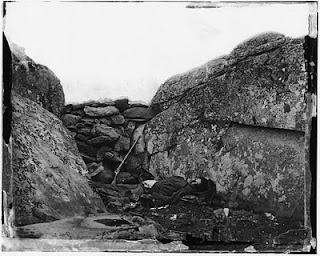
like this one:
[Alexander Gardner / Gettysburg / Dead Confederate soldier in Devil's Den / wet collodion / July 1863]

if you click and blow this picture up, you can see all the amazing details, from the buttons on the soldier's uniform, to the cracks and moss in the rock. but beyond that stone wall, just empty whiteness, the hazy blur of a line of trees, nothing. it's so poignant. so much in the immediate before our eyes, and nothing beyond. transfixing!

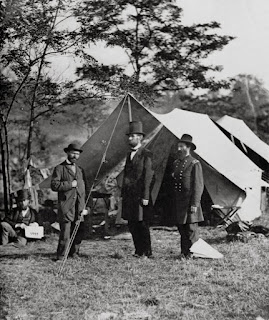
also, looking thru historic photographs helps us to appreciate the clarity and detail in which modern life is preserved. the past has become a mythic blur in fuzzy bygone daguerrotypes. take, for example, a photo of Abe Lincoln from the Civil War:
his face lacks detail, stability, you can make out a rockin' beard and a kindness in his face, but it's mostly hidden in shadow. mysterious, beguiling, regrettable.

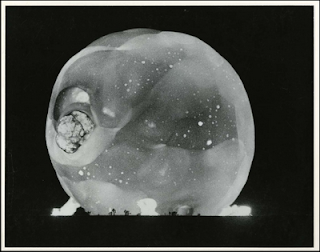
finally! be sure to also check out this article from NPR about photographs of atomic bomb explosions. way cool, way creepy and way way unbelievable (i could not, for the life of me, see the explosions. i kept thinking they were microbes. until i saw the trees in the bottom. whoaa!)

[Photograph taken by Harold Edgerton with a rapatronic camera, from the Smithsonian Museum of American History]

Wednesday, May 26, 2010

Facebook and the future of electronic media history

hot dog! every since my post about quitting facebook, i've been checking QuitFacebookDay.org every morning to see if they've made progress on their commitment numbers. i've been amazed to watch its trending in the last week or so, this morning at 10 am up to 20,123 and now suddenly up to 22,284 as of 1 pm PST today! every other morning the site has seen a growth of only 1 or 2K people, but 5K wow! word is spreading!

that's because Facebook is losing a grip on its PR. just this morning On the Media ran a little story on Facebook. here's an excerpt:

RYAN SINGEL [a writer for Wired.com]: [Mark Zuckerberg’s] a really interesting character. There’s a book about to come out, by David Kirkpatrick, I believe, from Fortune magazine. The excerpts that have come out have been fascinating. For instance, Microsoft came along and told Facebook they'd be happy to buy it for 15 billion dollars, and Mark Zuckerberg said no. And then they came back and they said, we'll buy it over a period of five years, so we'll let you stay in control. He said no again.

This isn't about the money. And he really wants to sort of change the world, and he really wants that Facebook page to be the place that people define themselves to everyone else online.

On Tuesday, Facebook’s public policy director, Tim Sparapani, said something that was, I think, a bit of a slip, when he said that the personalization that Facebook has offered to all the websites on the Internet [...] he called that an “extraordinary gift to the public.” I think they really think that they're doing this amazing thing for the public and we're not thankful enough.

BROOKE GLADSTONE: And the gift to the public is the fact that their information can be shared with so many vendors out there.

electronic media history is about to repeat itself. Facebook is to our web experience what the conglomeration of TV (ABC, NBC, CBS) was to television programming. with consolidation into one large corporation, rather than the diversified, differentiated offerings of multiple sites for different purposes (i.e. Flickr, blogger, Last.FM, LinkedIn, etc.) the public loses out on richness of experience. we self-impose our lack of choice. ironic, in a state where consumer choice becomes our most frequent and salient experience of democracy, we still choose convenience over variety of choice. Brooke Gladstone points out in the same piece that the average Facebook user "will choose convenience over privacy every time." the bad press, the QuitFacebook movement, and the premature buzz over alternatives such as Diaspora gives me hope that maybe we won't see history repeat itself, that we will avoid corporate control of the internet, we will reclaim net neutrality, preserve our right to privacy, and utilize the internet for its fabled purpose, of making voice and choice more readily available and exercisable by the masses.

all together now!Link
-stef

Tuesday, May 25, 2010

living in the digital age

fyi, anyone born post-1977 is a "digital native" and anyone pre-1977 is a "digital immigrant."

this video is terrifying.


this makes me rethink the "digital divide": my students may not have access to computers at home, but at least someone in their home has a smart phone with internet access. the digital world at their fingertips, and not a clue how to use it. frightening.

Tuesday, January 05, 2010

déjà vu: a comparative analysis of James Cameron's Avatar

i watched Avatar with my fam last night. i enjoyed it, really, and maybe one of the most enjoyable facts was how my dad and i became really absorbed in the narrative, [spoiler alert:] cheering on the Na'vi, boo'ing the imperialists/capitalists/US foreign policy surrogates.

for those of you who haven't seen it yet, i would recommend seeing it soon, but mostly because i think the theatre surround sound and giant image add a lot to the experience. if you can, see it at a 3D iMax (which we did not, [my mom and i get motion-sick] but the whole time i wondered what it would be like [probly the closest to tripping on acid i will ever get]).

those of you who can't afford to see it in 3D iMax (esp those of you in CA, where those tickets can cost close to $20!), let me save you some of the suspense: my brother called it cliché, "it had the same gist as The Last Samurai and Dances with Wolves." (mm, not true? i believe in The Last Samurai the "natives," that is, the samurai, actually lose. and i haven't seen Dances, but at least it didn't distort or adulterate a historically significant theme [colonialism vs. "native" culture] with fantastical allegory, at least Dances was explicitly and unequivocally talking about Native Americans... right?)

despite its predictable story arch, Avatar does throw in some delightfully sharp jabs at recent foreign policy, mainly, US adminsitrations' predilection for forgoing diplomacy and resorting to force – quotes such as "fight terror with terror" and "shock and awe" were pulled right from Rumsfeld's mouth, generating huge snickers from me and my dad. (i wonder, too, about how uncomfortable the film might make staunch republicans, Bush fans, FoxNews junkies, Glenn Beck nutsacks, and jingoes, once they get past the colorful images and realize that the film is asking them to cheer against what they believe in. has Glenn Beck seen Avatar and/or done a review yet?)

Avatar, just like Lord of the Rings before it, uses the winsome conceit of fantasy to send us a much-needed message about how our modern lives are ruining the beauty of the world around us (indeed, the world without us). Avatar allows us to sink just deep enough into its fantasy to absorb its message, but i wonder if the message gets left behind as soon as we leave the world of Pandora and step out of the darkened movie theatre. as a kid watching the LOTR films, i eagerly took up where Peter Jackson left off, i wanted to be a hobbit and live in a Shire-like community, and i felt that meant we needed to protect our (Middle) Earth better. i started an environmental club at my high school, i got my family to recycle more and waste less. small actions probably, but illustrative. in contrast, leaving the theatre after Avatar made me feel exhilarated, but more in a "wow, what a really awesome movie" kind of way (residual spectacle). later, i felt bitter and angry as my thoughts turned to the surge in Afghanistan (no thoughts about the beauty of earth and nature).

i guess the significant difference between these two comparable films is this: while LOTR grounded its story in something fantastical, it still seemed plausible (warriors who looked like nothing stranger than medieval crusaders, trees who could walk and talk – this doesn't seem so strange if you accept the idea that the natural world is teeming with life and hidden beauty, which i do). Avatar, to use a phrase from the main character, was too "dream-like" to be real. and that's the problem, it is real. wars against native peoples and cultures happen all the time, thru brutal, irreverent force and extermination, and ppl don't see it or don't care. what good does it do for these things to be brought to the surface but to be forgotten in spectacle?

finally, a word about representation: i found it difficult to enjoy the movie for the first half an hour or so, because i was deeply disturbed by the way the "natives" were depicted. long braids, tall alien-like bodies and cat-like features, broken english, scarce clothing, hissing and animal-like agility... it was a biting reminder that our society often thinks of ethnic as "strange" or curious (disturbingly, something about the Na'vis faces, in addition to looking cat-like, suggested that the actors playing them were ethnic, which was what prickled me most ["native" = ethnic, colonialists = "white"] because it suggests that ethnic peoples are somehow wild or alien). for more on what i mean, see this article on what it means to wear "ethnic" fashion.
(update! this article from a really great website on representation, picks Avatar apart quite aptly. again, spoiler alert!)

and, for those still wanting to see the movie but without the means to do it, this video sums it up nicely as well:


-stephan!e


edit! found this great image that sums it up pretty nicely:

Wednesday, April 29, 2009

hope

"you cannot live on hope alone,

but without it, life is not worth living."
- Harvey Milk


i have got to give it up for this video:


great graphic design and editing, highlighting excerpts from Harvey Milk's speech "You Cannot Live On Hope Alone" (1978). i got chills just watching it, and an itch to take to the streets and fight for something, fight for everyone's right to love whoever we want.

---

another speech that will absolutely move you to tears: Dustin Lance Black's Oscar acceptance speech for his original screenplay for the film MILK (2008).


what a senseless world we live in if beautiful people like these must be told they are anything less by our government and corporatized media.


---
finally: if you haven't seen it yet, you should definitely watch The Life and Times of Harvey Milk (the original documentary on which, i'm assuming, Milk was based, and Hulu has it for free!) i watched this as a sophomore in college, in a gender and sexuality in literature class, and remember crying for hours after, wondering how i'd gone my whole life without knowing about Harvey Milk, and feeling so sad that people like this, brave and beautiful ppl, are taken from us before they can do all the good they can.

Saturday, March 21, 2009

dancing in the dark

i've said it before, and i'll continue to say it again: i love The Boss.


nothing encapsulates the complexity of being born in america in the 1980s like Springsteen and synthesizer, and i mean this in earnest. while the musical and cultural products of the '80s as a whole would seem to have tainted history's perception of the decade, what with the proliferation of horrible one-hit wonders and abusive overuse of the moog, The Boss remains the 80s' single greatest gift to American music. and what's more, he's the gift that keeps on giving (thank you!)

that's because there is a permanence to Springsteen's music that defied the limits of 1980s materialism and spectacle (the same values American Psycho critiques in this scene). while '80s hair bands and rock groups found short-lived success by cannibalizing tried and true guitar riffs and appealing to a brief moment's gaudy aesthetics and conventions, Springsteen wrote epic stories about human suffering and loneliness, about working night shifts in steel factories, driving thru abandoned city streets, love, desperation, the hunger and hope for a better life. in short, the american dream and the american way of life.

and though Springsteen's staunchly american aesthetic can be a deterrent to some (my boyfriend once described it as "jingoistic"), it is precisely the way in which he represents America that i find seductive. he sings of heroes doomed to Sysiphean fates, working low wage jobs and searching for escape. unlike the ass-kicking beer-swigging mythos of modern country music, Springsteen's music is complex, genuine, underscored with hardship and persistence. while the former are simulacra, Springsteen's America possesses a history of emotion and suffering. yet, there is a gloomy/gritty hopefulness – despite feeling so defeated, there remains release and splendor, in a midnight drive, in a passionate embrace, in that guitar, in that harmonica, in a dance in the dark.

this is an America i can identify with and feel proud of, one that struggles to overcome disillusionment, but struggles unflichingly.

---

to put it in other terms: i rediscovered the album Born in the USA this weekend, 2+ decades after its initial release. i was reluctant to listen to it, not knowing if the music would translate well over the expanse of time. i worried that the synthesizers would make me cringe. but this is perhaps a fitting example of the complexity i'm talking about, that the same music revisited not only revealed layers, but became more beautiful because of its history coupled with my experience. the synthesizers not only go unnoticed, but sound like organs. they're an artifact of the zeitgeist of the 80s, but not a distractor from the permanence of the music.

i used to listen to Bruce Springsteen in the car with my mom on the weekends. his music would come on the radio and i would sing along to words whose sentiments i didn't fully understand. back then, i only understood them as a widely experienced "happy" feeling, the same excitement as a surprise trip to get ice cream, or a snow day.

as a young girl growing up, watching the "Dancing in the Dark" video would make me so terribly happy that the only logical impulse was to dance uncontrollably in the living room of our suburban house, flailing arms and kicking my legs, pretending to snap, shaking my hair. to be honest, i still do that. Courteney Cox was a real-life hero as far as i was concerned, b/c she had the balls to get up on stage and dance with The Boss. i wanted to be her. i mean, who didn't?


but i feel even more elated watching this video today, myself now a grown woman, as i listen to the lyrics, which speak to me in ways i couldn't have understood them before:

I get up in the evening
and I ain't got nothing to say
I come home in the morning
I go to bed feeling the same way
I ain't nothing but tired
Man I'm just tired and bored with myself
Hey there baby, I could use just a little help

[...]

Message keeps getting clearer
radio's on and I'm moving 'round the place
I check my look in the mirror
I wanna change my clothes, my hair, my face
Man I ain't getting nowhere
I'm just living in a dump like this
There's something happening somewhere
baby I just know that there is

[...]

You sit around getting older
there's a joke here somewhere and it's on me
I'll shake this world off my shoulders
come on baby this laugh's on me

Stay on the streets of this town
and they'll be carving you up alright
They say you gotta stay hungry
hey baby I'm just about starving tonight
I'm dying for some action
I'm sick of sitting 'round here trying to write this book
I need a love reaction
come on now baby gimme just one look

You can't start a fire sitting 'round crying over a broken heart
This gun's for hire
Even if we're just dancing in the dark
You can't start a fire worrying about your little world falling apart
This gun's for hire
Even if we're just dancing in the dark
there's a restlessness i can identify with here, as i sit in my apartment in LA, wondering how i got so caught up with my job, feeling old, wondering where the excitement went in my life. i'm tired of sitting around getting older, trying to write this book, i'm tired of having nothing to say, and worrying about my little world falling apart. i ain't nothing but tired, i'm just tired and bored with myself. i'm dying for some action, i want to dance, i want a little spark.

and this is why i love Bruce Springsteen. there is endurance in his music that never fails to make me happy. i listen to his music now and understand, completely, why every man, woman and child growing up in america for the last few decades has been absolutely seduced by his dream of america.

-stephan!e

to help make my case:
"I'm On Fire" [mp3]
"Thunder Road" [mp3 - how can you not fall in love with that harmonica solo?]
"Thunder Road (Live in 1999)" [mp3]

+ a fellow blogger's analysis of Springsteen's music and a comparison to the Stones.

+ Bruce Springsteen's website, with lyrics and audio clips.

Thursday, January 22, 2009

post-Inauguration Day notes

post-Inauguration Day realizations:
-i remember being extremely turned off by the strong Christian fundamentalist undertones in the speeches and ceremony, and especially by this guy:

(edit: and how fitting. the video, like the man, just doesn't seem to want to shut the hell up. it starts without you wanting it to, one of my ultimate peeves when it comes to internet usability: the automatic video that creates loud obnoxious sound when you don't want it)
(edit 2: fixed! - 1/25)

Warren's invocation made me extremely uncomfortable, thinking how the separation of church and state is really just an empty promise. and the part about asking forgiveness from Almighty God when we disgrace our fellow human beings and the environment made me extremely upset and angry, as we are fully aware a war (a genocide) is raging in Gaza, and we are content to just "ask forgiveness," shrug off any awareness of reality, as if it was all in God's plan. that kind of rhetoric is dangerous and had me gritting my teeth the whole time.

-the hope/change sheen is wearing off pretty quickly, too. i've been a huge cynic/buzzkill since november anyway, but i can pretty safely say that i am ready for the novelty of the moment to wear off so America can quit fantasizing and day-dreaming and snap back to reality. things do not change overnight. i don't know why i'm not as excited as everyone else seems to be about the new administration, i guess b/c i don't see substantiating empirical proof for the improvement, and i honestly cannot grasp the significance of having the first Black President. i know, i know, it must be absurd/impossible for other ppl to understand, but i, personally, do not feel that sense of awe and wonderment that everyone else seems to have in seeing a Black man as President. it does not surprise me that Obama is President now, and it makes perfect sense, so i guess i just don't get what all the fuss and pageantry and adoration is about, b/c frankly it just makes sense. i dunno, call me racist if you want to, the funny thing is that i think i feel this way precisely b/c i don't see race as any factor in it.

-i remember being surprised by how charged and passionate my students were around Election Day. i noticed many of my students taking vehement opposition to one another's political views, showing off their limited knowledge of campaign slogans and parroting rhetoric in transparent efforts to back up their support of a candidate they'd chosen to represent a deeper-seated world view and political affiliation. i noticed all my Black kids were for Obama, wore shirts with his face emblazened on the chest, would yell his name as if it were a cheer, would cheer at the mention of his name. the interesting thing about this was that usually, my Hispanic kids would grow silent, look sullen and sink down in their seats, would tell me later when i could hear them whisper, "i wanted Hilary to win." the braver ones would pretend to joke in class, "McCain for President!" what i came to realize later was this stance was chosen not out of opposition, but as reaction. true, some of my Hispanic students' parents probably legitimately supported Hilary and her pro-Hispanic community campaign. but what it came down to, perhaps, was a sign of bitterness towards what had obviously become a race race. when the nomination and the election came to be framed as a race issue, it became less about issues, and more about identity and belonging. who was going to be recognized and included, and who was going to be left out? when it seemed like Obama would win by indisputable margins, the election discussion in my classes became about control, and controlling who gets to stand for one's identity: "if this Presidency is supposed to represent me and my country, i want someone i choose, not someone thrust upon me. i want someone who can understand being the outsider, i want someone who can understand being left out, i want someone who can understand being misunderstood, i want a woman, i want an underdog, i want a Republican..."

Monday, January 19, 2009

Tuesday, December 23, 2008

lonesome cowboy

On August 23, 1973, Jan Erik Olsson, on leave from prison, walked into Kreditbanken at Norrmalmstorg, central Stockholm and attempted to hold up the bank. Swedish police were called in immediately, two of them went inside, and Olsson opened fire, injuring one policeman.

The other was ordered to sit in a chair and "sing something."

He started singing "Lonesome Cowboy."


-----

Olofsson was a repeat offender who had committed several armed robberies and acts of violence, the first committed at the age of 16.

He walked around in the vault singing Roberta Flack's "Killing Me Softly".


(from the Wikipedia article about the Norrmalmstorg robbery, which originated the theory on Stockholm Syndrome)

Monday, June 09, 2008

Bill Moyers is my elvis

as i usually do in the summer, i've been setting my alarm to wake me up to Democracy Now (sometimes it's the only way i can get up in the mornings).

and today, in a foggy half-sleep state, i thought i was dreaming of the '60s and listening to a poet, back from the dead, encouraging us to revolt and revolution. i was confused.

but as i gradually gained consciousness and listened more closely, i realized what i was actually hearing was a journalist's plea to the American ppl, and that this was actually the keynote speech at the National Conference for Media Reform which i was invited (and now regretting declining) to attend.


the speech itself was beautiful, the pace reminiscent of Ginsberg's "Howl", the urgency appropriate for our times. the post-speech was pretty awesome, too. as Amy Goodman explained, Bill O'Riley (yes, i spelled that wrong. no i'm not gonna change it. that's how much i care) and his slugs were "outing" Dan Rather and Bill Moyers as "leftwingnuts" for speaking at this conference with "these people" (read: progressives, liberals, media critics. oh my, indeed.)

apparently, they dispatched an O'Reilly factor producer to "ambush" and accost Mr. Moyers after his rousing speech. this is the verbal pounding that ensued:


it occurs to me that my generation has had the pleasure and honor of seeing several inspiring media moments in recent years:

Jon Stewart on CrossFire (2004):

"I'm here to confront you, because we need help from the media and they're hurting us..." (transcript here)

Stephen Colbert at the White House Correspondents dinner (2006) [click to play]:
"...And as excited as I am to be here with the President, I am appalled to be surrounded by the liberal media that is destroying America, with the exception of FOX News. FOX News gives you both sides of every story: the President's side, and the Vice President's side." (transcript here)

these have had the collective impact, for me anyway, of revealing the spectacular theatre of mainstream news media, and encouraging citizens' critical investigation and dissent.

as Bill Moyers said: "it's up to you to remind us that democracy only works when ordinary people claim it as their own."

-stephanie

Wednesday, July 18, 2007

the naming of things + 80's popculture + Chinese culture

[written 7/9/07, ~2 am]

my mother and i go for a walk in our neighborhood. it's just after 9, and on this mid-summer evening, the sun has only just set. everywhere, tinted blue and violet, but the humid stickiness of the July heat lingers in the air.

we walk in silence. i'm cranky with sleep, my jet lag and summer restlessness manifesting itself as unjustified moodiness, worsened by my frustration at the lack of conversation. my mother walks briskly, bumping into me on the awkwardly narrow sidewalk as we try to walk abreast of one another, the overgrown bushes nudging us into each other every twenty paces.

the tension is thicker than the summer humidity. i watch her bite her nails, wondering too why she can't carry on a conversation with her own daughter.

so tonight, i ask my mother about names, and how she and my father chose mine.

while the name i intend is actually my english name [Stephanie], my mother jumps immediately to my Mandarin name - Hsiao Jing (this disparity makes me flush slightly), explaining that my paternal grandmother chose my name. she then explains the Chinese naming process, a kind of "poetry."

she describes a poem, epically wrapping back in time, mapping generations and tracing family trees by stanzas and refrains. each branch of family history signaled by a line of poetry. i imagine an endless scroll, unwinding to reveal the flash of character that is my name.

"American names," she says, "are easy."

"They're just sounds. You just pick what sounds best."

my American name: purely 80's. my parents were deciding between 2 names - Connie and Stephanie. why those names? "because Connie Chung was well-known at that time," my mother explains, "everyone knew who Connie Chung was." and Stephanie? "after Princess Stephanie" (of Monaco). finally, they chose Stephanie because "Stephanie Lee" sounded better than "Connie Lee" (and thank heavens they did).

my brother's name is a similar story. Kevin was a popular name at the time (i can't help but wonder if this is at all a credit to Kevin Bacon's 80s fame), and Calvin Klein was hitting it big in the 80s. they thought Calvin Lee sounded better (little did they know that as a kid my brother would go around introducing himself as "Calvin, as in Calvin and Hobbes").

my mom then goes back to a day long before i was born, she is a beautiful young school teacher, accompanying my father as they move to Kentucky for his new job at the university. i imagine her face in the passenger seat window, gazing out, pondering names during the long drive before she arrives at the new home, stepping out of the car, suddenly "Angela" (b/c Americans never pronounce her given name with the beauty and delicacy it requires: Hsiao Hwa, like a fragile flower. it has the effect of dissociation, disconnect: "I never know if they're talking to me or not").

she goes back further still, to a day long before she married my father, she is a beautiful young university student, studying German, and she goes by Sabrina, Karinne, Sonya. a different name for every teacher.

as we come up to our driveway, i try Sabrina on my tongue, and try to remember the feeling of it, to store it in my mind in case i ever have a daughter... Sabrina.

---
memories like mohair sweaters,
Stephanie Lee / Li Hsiao Jing

Monday, January 29, 2007

my take on the kuleshov experiment, with gnomes

i spoke with my media aesthetics professor today and she said i could try creating an internal conflict. this, rather than an explicit narrative arc, is more appealing, but also more difficult. i'm not interested in crafting a dialogue, but am more concerned with providing the images that will elicit the dialogue themselves. i'm fairly laissez-faire in my own affairs, why not be that way with my art?


i'm so picky. is that the sign of an artiste? or mis-direction?
---
i've decided this gnome project could take a Lev Kuleshov historical turn. for those who don't know, the Kuleshov experiment took the same shot of a man with a neutral expression and juxtaposed it with images of different things: food, a woman, a funeral, and found that ppl read different emotions into his expression, based on their own associations.

see a short clip from the experiment here:

since i am working with a non-expressive, fixed/static subject (geoff), the responsibility for emotive effect lies solely on me and my ability to manipulate the images in just the right way.

only instead of intercutting images, i'm using lighting and camera angle to create my effects.

you see what i mean?