"Fire is motion / Work is repetition / This is my document / We are all all we've done / We are all all we've done / We are all all we've done / We are all all defenses."

- Cap'N Jazz, "Oh Messy Life," Analphabetapolothology
Showing posts with label dreamers. Show all posts

Tuesday, November 09, 2010

intergalactic dust

huzzah, readers! a friend of mine pointed out to me just an hour after my last post that today is Carl Sagan day. so, in honor of our galactic dreamer, i'm posting his famous "Pale Blue Dot" quote about the in/significance of Earth in the broader context of our universe.

to the stars, friends.
-stephan!e

a photograph of Earth from the Voyager spacecraft, taken on its way out of the solar system. Earth is the tiny dot located halfway down inside the brown beam on the right.

From this distant vantage point, the Earth might not seem of particular interest. But for us, it's different. Look again at that dot. That's here, that's home, that's us. On it everyone you love, everyone you know, everyone you ever heard of, every human being who ever was, lived out their lives. The aggregate of our joy and suffering, thousands of confident religions, ideologies, and economic doctrines, every hunter and forager, every hero and coward, every creator and destroyer of civilization, every king and peasant, every young couple in love, every mother and father, hopeful child, inventor and explorer, every teacher of morals, every corrupt politician, every "superstar," every "supreme leader," every saint and sinner in the history of our species lived there – on a mote of dust suspended in a sunbeam.

The Earth is a very small stage in a vast cosmic arena. Think of the rivers of blood spilled by all those generals and emperors so that, in glory and triumph, they could become the momentary masters of a fraction of a dot. Think of the endless cruelties visited by the inhabitants of one corner of this pixel on the scarcely distinguishable inhabitants of some other corner, how frequent their misunderstandings, how eager they are to kill one another, how fervent their hatreds.

Our posturings, our imagined self-importance, the delusion that we have some privileged position in the Universe, are challenged by this point of pale light. Our planet is a lonely speck in the great enveloping cosmic dark. In our obscurity, in all this vastness, there is no hint that help will come from elsewhere to save us from ourselves.

The Earth is the only world known so far to harbor life. There is nowhere else, at least in the near future, to which our species could migrate. Visit, yes. Settle, not yet. Like it or not, for the moment the Earth is where we make our stand.

It has been said that astronomy is a humbling and character-building experience. There is perhaps no better demonstration of the folly of human conceits than this distant image of our tiny world. To me, it underscores our responsibility to deal more kindly with one another, and to preserve and cherish the pale blue dot, the only home we've ever known.

Sunday, October 31, 2010

Why Mondo Should Have Won: Project Runway, the American Dream, Mondo Guerra, and the depiction of difference in reality television

you'll always be a winner in our eyes, Mondo

I just can't believe that Gretchen, who seemed to only skate by challenge after belabored challenged, made it to the final, and then was declared the winner. It felt like I was being slapped in the face. I feel insulted as a viewer of the show. Forget about fashion and aesthetic, because that is all, as Kors said, "subjective." It''s sometimes painfully clear that the judges are making decisions based on ratings rather than actual design. Michael Costello, debatably, made it much farther in the competition due to his ability to stir up drama, than on his talent alone. The same, I think, could be said of Gretchen, who repeatedly showed drab, boring clothing that sank her to the bottom two. She clearly knew how to play the reality TV game, and to her credit, it served her well. Too well. Her spot in the final three was a credit to her ability to manipulate, to pander to the camera, and stir up drama.


When the judges and producers were making their final decision, they really should have thought about taking the pulse of their audience. I think that it should be apparent, to anyone at this point, that PR is less a show about fashion, than it is about ratings. PR has struggled with ratings and maintaining a steady viewership, going from being an exciting new reality show when it first debuted on Bravo, then being downgraded to Lifetime (network for sad housewives). You'd think the PR producers would be more careful with their audience. Instead, Season 8 took us repeatedly through confusing and catty judging, deplorable camera-pandering and unnecessary drama-stirring (from Ivy to Michael C. to Gretchen) and yet, in the midst of all that, Mondo was a consistently shining star. He was endearing in all his faults, and amazingly, honestly, real. He had real struggles and tribulations to overcome, yet through all that, his talent was apparent and brilliant, and his personality and demeanor, his conduct with fellow contestants and his candidness with the audience, were classy and heartfelt. Every week, I tuned in to watch, not because I care about fashion, but because I cared about Mondo, because I had a genuine interest in his talent, and because watching his struggle with darkness and the conversion of pain to deplorable, exuberant beauty and joy was heart-wrenching, captivating, and deeply inspiring. The PR producers must not have known it, but they'd stumbled upon a reality tv treasure, someone who not only delivered beautiful art, but had a touching message for our troubled times. And that is something much higher, much more important, much more real and much more permanent than "fashion." It was talent, it was life, painful and dark and compromising and imperfect life. And that is why so many viewers, so many young people, so many minorities and people of color and queer (and straight) people loved Mondo, cheered for Mondo, needed to see Mondo win.


Even in terms of the fashion, it established a binary between White/bourgeois/safe/acceptable and minority/carnivale/risky(risque)/daring/marginal. Despite Nina's comments that Gretchen's collection was more "ready to wear" and thus, more salable, it was, to be honest, ready to wear and salable to a very specific demographic: hipster girls with money. Mondo's collection, though theatrical, was not strictly high fashion in the sense of couture and extravagant money and luxury. These were clothes made from a man who has suffered and lived on the edge of privilege but never been a part of it. Gretchen, despite all her weepy confessionals to the camera about credit card debt and homelessness, has had much more access to material wealth and privilege, and it shows in her designs. When she makes clothes, they're for herself, for what she envisions women to be, what she thinks women want to be. And, to be honest, it's a very white-washed, hipster aesthetic. It also must be noted that though they are "easy sexy" and bohemian in feel, they are made for a higher class woman, and nothing irritates me more than bobo couture (bobo = bourgeois bohemian). It's the same irritated feeling I get when I go shopping and I hear hipster elitists lamenting the common people's refusal to commit to organic food and locally grown produce and blah blah. Look, while I buy local and organic as much as I can, I don't judge and patronize others for not having the means to do so. Organic food is very much a privilege perpetuated by poor farming and agricultural practices as well as government subsidies. But, I'm getting sidetracked.


Mondo was so refreshing to watch because what he produced was new. He possessed so much raw talent, was guided and inspired by personal experience and cultural upbringing, that it felt like he was not only introducing a new, daring aesthetic to the world, but a new perspective, a new experience, and one that has been largely ignored and been waiting to gain recognition and voice. Mondo had given this experience - of suffering, of marginalization, of being an outcast and being misunderstood - a voice and a face, and many viewers latched onto that, became endeared to that.


What irks me most about the finale is what it seems to say about our culture, and race, and class, and tv. Mondo represented an epic underdog of the times - an HIV-positive Hispanic gay man, with artistic aspirations - battling it out to have his dream validated in a modern arena - a reality tv show - against a waifish blond girl from, ostensibly, the upper-middle class. Giving Gretchen the win was like denying that dream that all of us shared with Mondo, and denying that importance that he gave to that story so many people share. It was saying that tv and "fashion" were more important than passionate, real life and talent. And, I think because of that, a lot of people will turn their tvs off to PR in the future, if they haven't already. I didn't even bother finishing watching the episode. It smacked a little too much of "to the victor go the spoils" and I wanted to remember, instead, an alternate reality where I thought it was possible for the Mondos of the world to win.


Saturday, October 30, 2010

Why Mondo Should Have Won: Project Runway, the American Dream, Mondo Guerra, and the depiction of difference in reality television

you'll always be a winner in our eyes, Mondo

I just can't believe that Gretchen, who seemed to only skate by challenge after belabored challenged, made it to the final, and then was declared the winner. It felt like I was being slapped in the face. I feel insulted as a viewer of the show. Forget about fashion and aesthetic, because that is all, as Kors said, "subjective." It''s sometimes painfully clear that the judges are making decisions based on ratings rather than actual design. Michael Costello, debatably, made it much farther in the competition due to his ability to stir up drama, than on his talent alone. The same, I think, could be said of Gretchen, who repeatedly showed drab, boring clothing that sank her to the bottom two. She clearly knew how to play the reality TV game, and to her credit, it served her well. Too well. Her spot in the final three was a credit to her ability to manipulate, to pander to the camera, and stir up drama.

When the judges and producers were making their final decision, they really should have thought about taking the pulse of their audience. I think that it should be apparent, to anyone at this point, that PR is less a show about fashion, than it is about ratings. PR has struggled with ratings and maintaining a steady viewership, going from being an exciting new reality show when it first debuted on Bravo, then being downgraded to Lifetime (network for sad housewives). You'd think the PR producers would be more careful with their audience. Instead, Season 8 took us repeatedly through confusing and catty judging, deplorable camera-pandering and unnecessary drama-stirring (from Ivy to Michael C. to Gretchen) and yet, in the midst of all that, Mondo was a consistently shining star. He was endearing in all his faults, and amazingly, honestly, real. He had real struggles and tribulations to overcome, yet through all that, his talent was apparent and brilliant, and his personality and demeanor, his conduct with fellow contestants and his candidness with the audience, were classy and heartfelt. Every week, I tuned in to watch, not because I care about fashion, but because I cared about Mondo, because I had a genuine interest in his talent, and because watching his struggle with darkness and the conversion of pain to deplorable, exuberant beauty and joy was heart-wrenching, captivating, and deeply inspiring. The PR producers must not have known it, but they'd stumbled upon a reality tv treasure, someone who not only delivered beautiful art, but had a touching message for our troubled times. And that is something much higher, much more important, much more real and much more permanent than "fashion." It was talent, it was life, painful and dark and compromising and imperfect life. And that is why so many viewers, so many young people, so many minorities and people of color and queer (and straight) people loved Mondo, cheered for Mondo, needed to see Mondo win.

Even in terms of the fashion, it established a binary between White/bourgeois/safe/acceptable and minority/carnivale/risky(risque)/daring/marginal. Despite Nina's comments that Gretchen's collection was more "ready to wear" and thus, more salable, it was, to be honest, ready to wear and salable to a very specific demographic: hipster girls with money. Mondo's collection, though theatrical, was not strictly high fashion in the sense of couture and extravagant money and luxury. These were clothes made from a man who has suffered and lived on the edge of privilege but never been a part of it. Gretchen, despite all her weepy confessionals to the camera about credit card debt and homelessness, has had much more access to material wealth and privilege, and it shows in her designs. When she makes clothes, they're for herself, for what she envisions women to be, what she thinks women want to be. And, to be honest, it's a very white-washed, hipster aesthetic. It also must be noted that though they are "easy sexy" and bohemian in feel, they are made for a higher class woman, and nothing irritates me more than bobo couture (bobo = bourgeois bohemian). It's the same irritated feeling I get when I go shopping and I hear hipster elitists lamenting the common people's refusal to commit to organic food and locally grown produce and blah blah. Look, while I buy local and organic as much as I can, I don't judge and patronize others for not having the means to do so. Organic food is very much a privilege perpetuated by poor farming and agricultural practices as well as government subsidies. But, I'm getting sidetracked.

Mondo was so refreshing to watch because what he produced was new. He possessed so much raw talent, was guided and inspired by personal experience and cultural upbringing, that it felt like he was not only introducing a new, daring aesthetic to the world, but a new perspective, a new experience, and one that has been largely ignored and been waiting to gain recognition and voice. Mondo had given this experience - of suffering, of marginalization, of being an outcast and being misunderstood - a voice and a face, and many viewers latched onto that, became endeared to that.

What irks me most about the finale is what it seems to say about our culture, and race, and class, and tv. Mondo represented an epic underdog of the times - an HIV-positive Hispanic gay man, with artistic aspirations - battling it out to have his dream validated in a modern arena - a reality tv show - against a waifish blond girl from, ostensibly, the upper-middle class. Giving Gretchen the win was like denying that dream that all of us shared with Mondo, and denying that importance that he gave to that story so many people share. It was saying that tv and "fashion" were more important than passionate, real life and talent. And, I think because of that, a lot of people will turn their tvs off to PR in the future, if they haven't already. I didn't even bother finishing watching the episode. It smacked a little too much of "to the victor go the spoils" and I wanted to remember, instead, an alternate reality where I thought it was possible for the Mondos of the world to win.

Wednesday, March 14, 2007

enjoying Spring into Summer

listening to some experimental sound poetry*
+ reading Dharma Bums by Kerouac (my favorite book from a past summer)

= it's already summer in my head.

sayonara,
stephan!e
---

*on Michael Snow's "Sinoms" [mp3 for download]:
"In the 50-minute Sinoms, Snow has multi-tracked some 20 voices, with as many different French and English accents, reading a complete list of the mayors of Quebec City, at some points making a simple juxtaposition of pronunciation and at others creating the effect of a choir." - U B U W E B

i was first familiar with Michael Snow and his work Wavelength, an experimental non-narrative film. but i learnt today that he was first and foremost a jazz musician, in addition to a photographer, a sculptor, an artist.

some of his photographic work, quite compelling and filmic:

Authorization (1969) - currently my laptop desktop

Venetian Blind (1970)

Thursday, January 04, 2007

time travel is easy

yesterday, i showed you pictures from travel books i found from my childhood.

today, i share more intimate glimpses into the past.

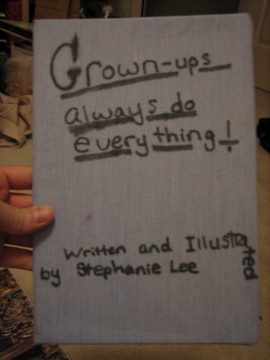
first, pictures from this book i made in Montessori school*:
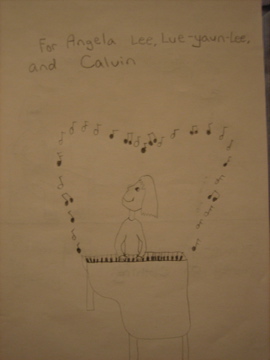
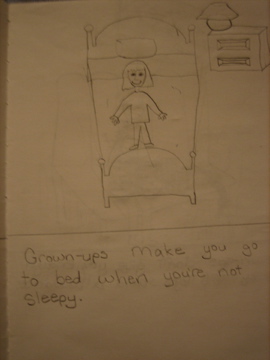
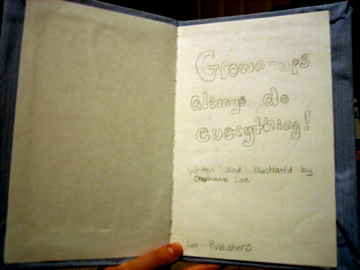
the scribbled "copyright" on the inside cover indicates that i made this in 1995. that was a full 12 years ago. the book is a delicate creation titled "Grown-ups always do everything!" and features 20 unique pages of pencil drawings paired with different privileges of the older class i envied as a 9-year-old imprisoned in the educational system.
it is handbound: as i remember, i drew the pictures in sequence in a booklet of salvaged computer paper, then folded the pages together, made holes in the crease and threaded them together. i then glued the end pages to the covers, which were cardboard pieces i covered in a soft fabric (you can see this detail in the photo).
(for those interested in the art of self-binding, this is a simplified version of case-binding.)

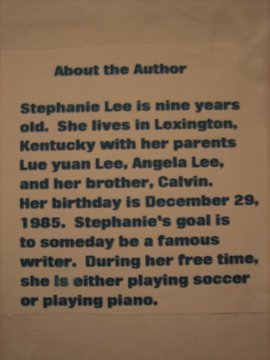
what i find most interesting was the "about the author" on the back inside cover:
notice how i mis-typed my own birthday (Dec 26, not 29) and how my goal "is to someday be a famous writer." where did that young girl go?

---

finding this treasure brings back fond memories of elementary school, and being left to my own devices, i recall spending recesses and afterschools playing with paper materials, making countless notebooks and sketchbooks of various sizes and colors, giving them to friends and family, keeping some for myself for later writing. i determined to use every book i made for a story or novel (as i said, i had dreams of being a writer. and evidently, a self-published one.)

i once gave a boyfriend a hand-bound book i made in 8th grade, a unique gift because i had marbleized paper for the covers, and bound it in japanese style, with a beaded tassle bookmark.

---

seriously, where did that young dreamer go?

finding these relics from childhood makes me feel sad for dreams i've let go. but it also gives me renewed faith in the person i am. and a sense of duty to the past.

but the past is merely a distant present. and the future is the present is the past. why leave book-binding in the past? why allow self-publication to be a left-behind childhood dream. i'm self-binding my senior thesis. let's call it a tribute to the dreamers.

tomorrow: more pictures from the past.

to the past, and its presents,
stephanie


*note to self: research the Montessori method for your senior project. according to Webster's, the Montessori method emphasizes developing children's "natural" interests, rather than following a strict formal curriculum. this has interesting developmental implications, and is as close a method to facilitated autodidacticism that i can think of in an extant institutional setting.